
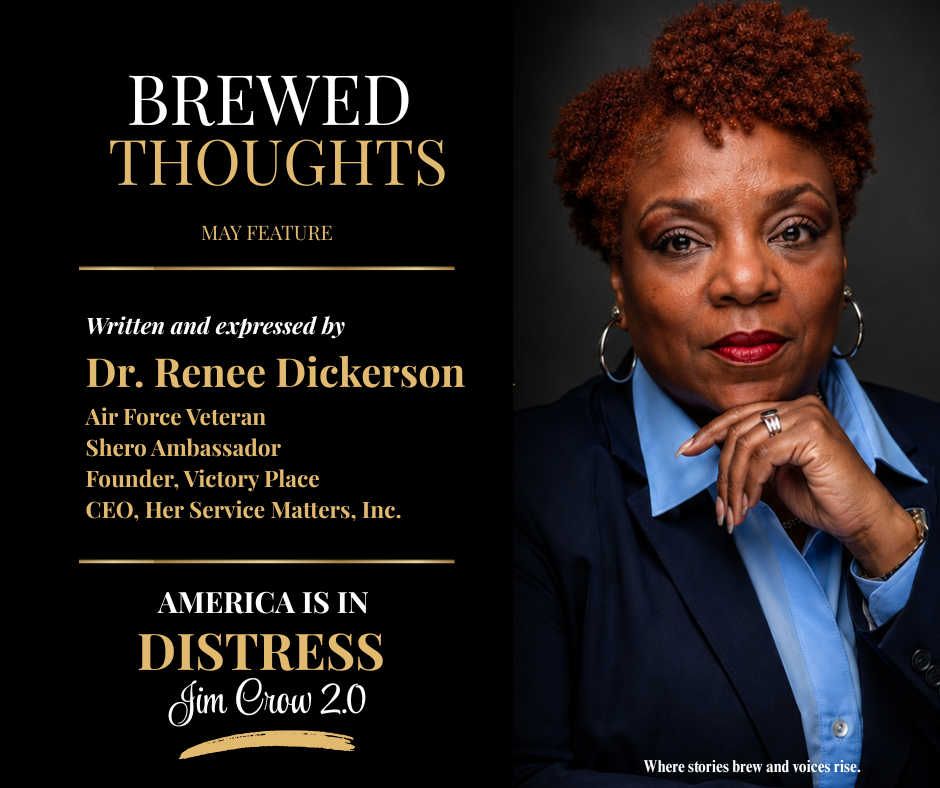
America Is In Distress: Jim Crow 2.0
- Dr. Renee Dickerson
- May 15
- 4 min read
My understanding of voting did not begin in a classroom or through a book. It began with living, breathing stories about my grandfather voting for the first time. The first time he voted was after the Voting Rights Act of 1965 was passed. Before that, he couldn’t. He had seen men lynched and castrated just for trying.
On Election Day in November 1965, he prepared with dignity—meticulously starching and
ironing his shirt and overalls until they stood on their own, polishing his shoes so brightly they
seemed to repel dust, and wearing a brown fedora hat to match.
In my family, that became folklore. His clothes carried superpowers. I was four years old, and
that is how I learned what voting meant.
For him, that day was not just participation—it was existence.
What I learned from my grandfather was that voting is embodied memory. It carries the weight
of those who risked everything for the chance to live fully, for themselves and their families. His starched clothes and polished shoes were not merely preparation; they were armor against a history that had tried to erase him.
That lesson stayed with me. Recently, as I wrote my Maurice Burke Paper—The Right to Speak, the Right to Be
https://ccpsa.org/resources/Documents/Dickerson%202026%20Maurice%20Burke%20Paper%20Prize.pdf)—I began to understand voting through a psychoanalytic and historical lens. Drawing on Frantz Fanon’s Black Skin, White Masks and the Holmes Commission on Racial Equality Report, I examined how systems silence voices through laws, fear, erasure, and internalized oppression. Voting rights, then, are both political and psychological protections. When those rights are weakened, the sense of self and belonging within a nation is too.
Today, that reality feels urgent again. While the Voting Rights Act of 1965 remains a landmark
achievement, court decisions and policy shifts have significantly weakened its enforcement. The protections that once ensured access are no longer as strong, raising concerns about diminished representation and renewed barriers. In this context, my grandfather’s story is both history and a warning.
James Meredith is a United States Air Force veteran who made history in 1962 by becoming the first Black student to attend the University of Mississippi. His courage helped break segregation and expand civil rights in America. Today, that same fight continues. Mississippi’s anti-DEI law (HB 1193) makes it harder for schools to teach or even mention people like James Meredith and other civil rights leaders.
Contemporary policy frameworks further complicate this landscape. Proposals from the Heritage Foundation and its broader initiatives, including Project 2025, reflect ongoing debates about the role of government, civil rights protections, and the direction of American democracy. Interestingly, the president of the Heritage Foundation studied our history and adaptive systems and has found and acknowledged a historical truth: Black women have been central to the nation’s development. They served as stabilizing forces within enslaved communities, maintaining family cohesion, nurturing children, preserving spiritual traditions, and sustaining intergenerational survival under unimaginable conditions. These adaptive systems blended African cultural traditions with the harsh realities of American slavery, fostering resilience where racialized systems were intended to destroy. This truth is a reminder that those most marginalized have often been the very ones holding our nation together.
Instead of the Heritage Foundation and its supporters expressing gratitude for Black women
being essential to improving the nation, they have utilized our history and adaptive systems to
establish Jim Crow 2.0. They are using their research to try to break our spirit by advancing anti-DEI rollbacks, reducing civil rights and voting protections, and perpetuating inequitable labor practices (e.g., limiting access to student financial aid, affecting health coverage for families, firing or laying off over 600,000 Black women since 2025, the Mississippi anti-DEI law, etc.). These efforts have intensified conversations about equity, accountability, and visibility. In response, women veterans and advocates are increasingly discussing economic power as a form of civic visibility.
One emerging idea is a National Women Veterans Blackout Week—a coordinated effort
encouraging everyone to avoid nonessential purchases, reduce discretionary spending, and
withhold economic participation from selected corporations or institutions perceived as
supporting inequitable practices. The intention is not economic harm, but visibility,
accountability, and civic engagement through collective action. The message is clear: if Black
women, including veterans, have helped sustain this nation through service, sacrifice, and labor, then their voices and economic contributions cannot remain invisible.
In many ways, this brings me back to something Cannonball Adderley once said about his song “Mercy, Mercy, Mercy.” He explained that the piece was about adversity—about what people say to each other when life becomes overwhelming: mercy, mercy, mercy. My grandfather’s vote was an answer to adversity. It was his way of saying that even in the face of terror, his voice—his vote—mattered.
Today, when I vote, I carry him with me. I carry the essence of those stories, the image of his
starched clothes, and the understanding that rights can be gained, weakened, and must always be protected—especially in times like these. Voting is not just a political act; it is a continuation of a legacy. It is how we honor those who endured adversity and ensure their sacrifices were not in vain.
Dr. Renee Dickerson
Dishonored Valor: When Honorable Service Is Met with Systemic Harm
The Million Women Veterans (MWV) March on Washington 2027


Great mission and great to enjoy coffee.
Powerful